Plant automation · KSA
Why IT Firms Keep Failing KSA Fabrication Plants — And What Actually Works
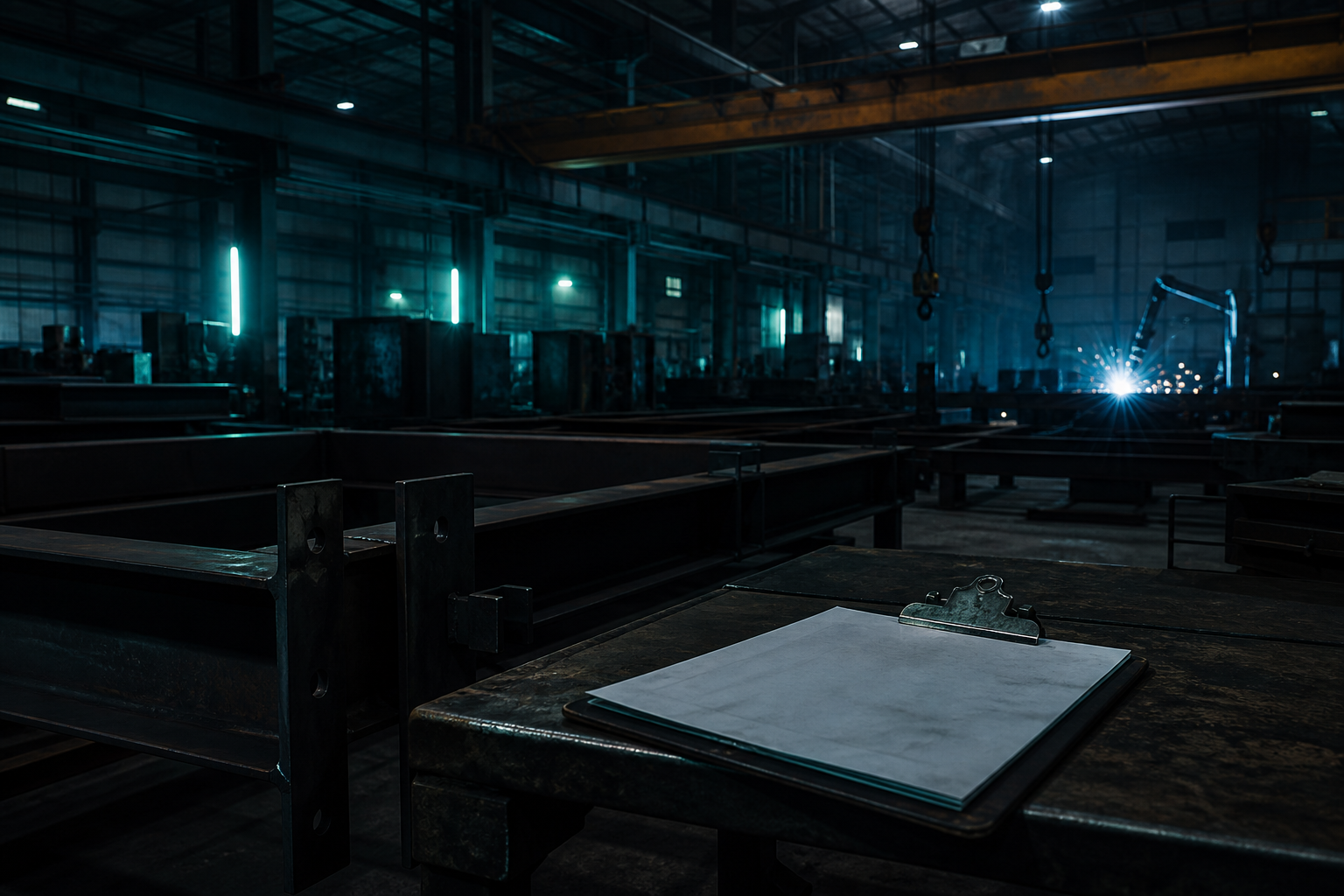
A steel fabrication plant in Saudi Arabia — 35 years in operation, Aramco sub-contractor — needed to digitise its shop floor. Production tracking was verbal. QC was paper-based. Delivery notes took four hours to assemble by hand.
They approached three IT firms. Each time: a proposal arrived, a price was quoted, and the project stalled. No system was ever delivered.
This is not an unusual story in KSA heavy industry. It is the norm. Here is why it keeps happening — and what a working system actually requires.
Why IT firms fail at this problem
1. They quote before they understand
Most IT vendors arrive with a solution already in mind. They map the client's operation onto a template they have sold before — an ERP, a project management tool, a generic workflow platform — and quote for configuration rather than understanding.
A fabrication plant is not a generic operation. Cutting, fit-up, welding, NDT, galvanizing, painting, final QC, and delivery are a specific sequence with specific failure modes. A QC hold at welding does not behave like a task status change in a project management tool. A wrong piece reaching the next stage is not a workflow exception — it is a quality incident with real cost.
Vendors who do not understand this build systems that workers ignore on day one.
2. They treat SAP as the enemy
Most KSA fabrication plants run SAP for procurement and materials. Most IT firms either try to replace SAP entirely — a multi-year, multi-million project — or refuse to touch it.
The working answer is neither. A shop-floor execution layer sits alongside SAP: SAP handles procurement, the execution system handles production. Job data imports from SAP; piece serials are generated automatically; the two systems stay in sync without a rip-and-replace.
Firms that cannot build this integration are solving the wrong problem.
3. They deliver software, not outcomes
A fabrication plant does not need software. It needs delivery notes that take 72 seconds instead of four hours. It needs QC holds that actually stop a wrong piece from moving forward. It needs a morning view that tells the production manager exactly where every piece in every active job is right now.
When IT firms scope a project as a list of features, the outcome is a list of features. When a project is scoped around the operational problem — the specific bottleneck costing the most time and money — the outcome is a working system.
4. They underestimate the floor
Office-based software works because the people using it sit at desks with good internet and time to learn. A fabrication floor is different. Workers are moving. Connectivity is patchy. Training time is measured in minutes, not days.
Systems that require workers to navigate complex interfaces, remember step sequences, or enter data twice get abandoned. A working shop-floor system is designed for the operator who has never used enterprise software — it shows exactly what to do next and nothing else.
What a working system looks like
At the Aramco sub-contractor plant in Saudi Arabia where Smart Factory is now live, the brief was not "build us a system." It was: fix the delivery note problem, stop wrong pieces moving forward, and give management a live view of production.
The solution addressed those three problems directly:
- Piece-level tracking from the moment material is cut — serial numbers generated from SAP import, not entered by hand.
- QC gates at every production stage — a piece cannot advance until the previous stage is approved. Wrong piece, wrong stage: the system blocks it.
- Delivery documentation assembled from live pipeline data — not from paper forms collected after the fact.
Three IT firms had tried before. The system went live in months, not years.
What KSA plants should look for
If your fabrication plant or EPC yard is evaluating automation, the questions that matter are not about technology:
- •Does the vendor understand your specific production sequence — or are they mapping you onto a generic workflow?
- •Can they integrate with your existing SAP setup without a rip-and-replace?
- •Have they built for shop-floor workers — people who need a system that works in three taps, not a dashboard designed for a boardroom?
- •Do they have a live reference site in KSA or GCC — or is your plant the first experiment?
A vendor who cannot answer all four questions clearly is not ready to solve this problem.
The cost of waiting
Every month a fabrication plant runs on paper, the costs are real and measurable: overtime on delivery documentation, quality incidents that reach the next stage before QC catches them, management time spent chasing status updates that should be visible in a dashboard.
The question is not whether to digitise. It is whether to keep paying the paper tax while waiting for a vendor who actually understands the floor.
Smart Factory is live in a KSA fabrication plant and available to EPC and fabrication operations across the GCC. Book a 15-minute demo — we will walk through the live system and map which modules fit your operation. Full product overview. ASTRA Group case study.
See the live system in 15 minutes
No slide deck theatre — we show the shop-floor pipeline, QC gates, and delivery flow, then map what fits your plant.
Book a demo